NaviGate successfully demonstrates onboard precise orbit determination aboard D-Orbit’s ION Satellite Carrier
ROME, 30 September 2026 — NaviGate, an Italian space technology company spun out of Sapienza University of Rome, has successfully completed the in-orbit demonstration (IoD) of NaviCode Caravel, its autonomous onboard precise orbit determination software, aboard an ION Satellite Carrier operated by D-Orbit. During the demonstration, NaviCode Caravel ran directly on the satellite’s onboard computer, computing the spacecraft’s position in real time using only the raw data of the GNSS receiver already onboard, with no additional hardware.
Today, knowing precisely where a satellite is remains largely a ground-based activity: operators rely on dedicated infrastructure, specialized flight dynamics teams, and repeated ground contacts to accurately reconstruct and predict the orbit of each spacecraft. As constellations grow in size and missions become more responsive, this approach turns into a bottleneck in terms of cost, workload, and reaction time. NaviCode Caravel moves precise orbit determination onboard: a software-only product that transforms the raw measurements of the GNSS receiver a satellite already carries into high-accuracy, real-time knowledge of its own position, available directly where operational decisions are made. Beyond determining where the satellite is now, Caravel can also predict where it will be, together with a measure of how reliable that prediction is, giving the spacecraft the forward-looking awareness it needs to anticipate upcoming events, such as ground station contacts or payload operations, and manage them autonomously onboard.
The demonstration was carried out through D-Orbit’s Software In-Orbit Demonstration service and structured in two phases. NaviCode Caravel was first validated on the ground on an engineering model replicating the in-orbit computing environment. The application was then uploaded to an ION Satellite Carrier already in orbit and executed onboard, processing real flight telemetry from the spacecraft’s GNSS receiver across multiple runs.
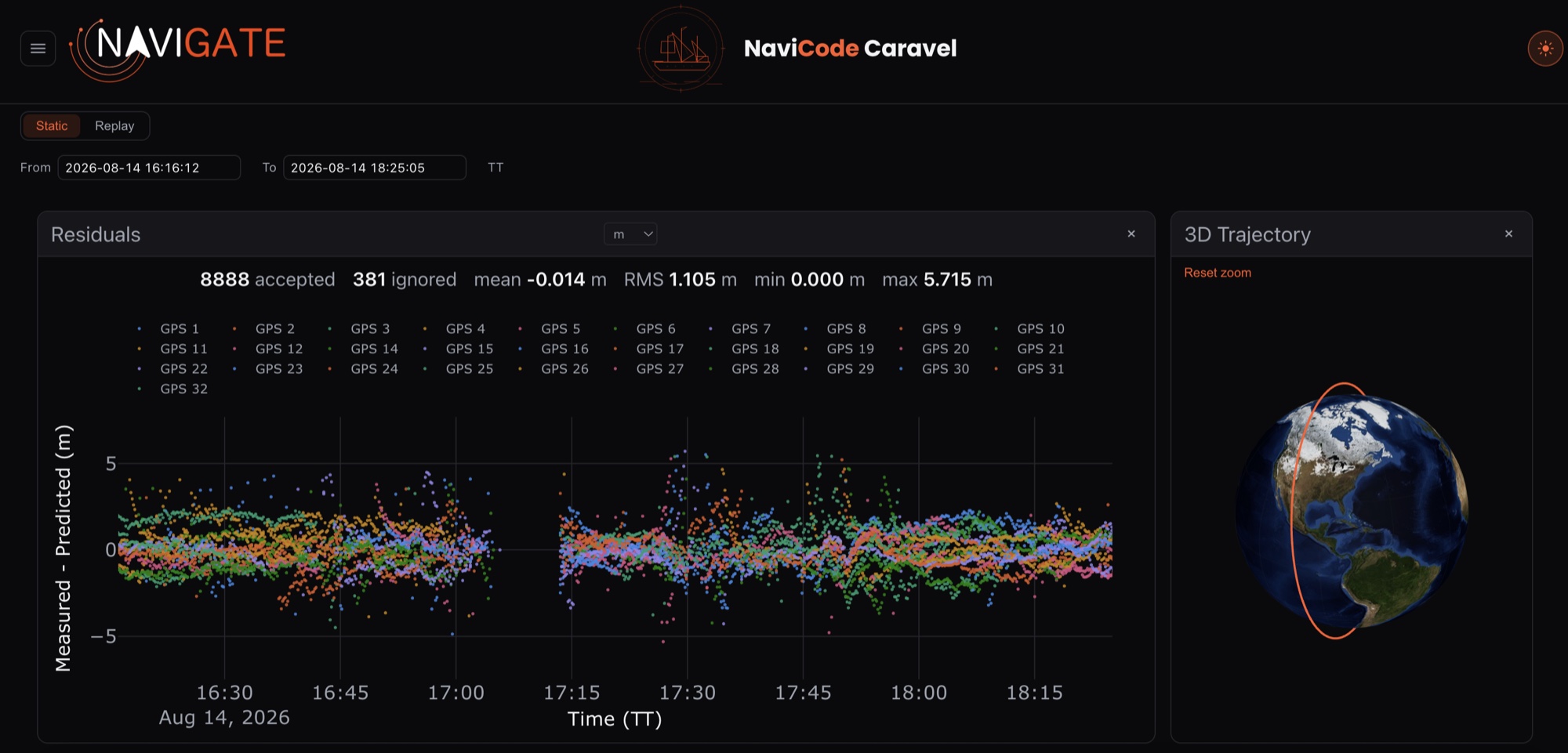
The software executed nominally onboard and in real time without anomalies. Onboard positioning reached a best-case formal uncertainty of 5.2 cm, with mean values in the decimeter range across the runs, using GPS-only measurements. NaviGate then verified the onboard solutions on the ground, proving them consistent with the reference orbits reconstructed through classical ground-based precise orbit determination performed with GODOT, the European Space Agency’s flight dynamics software. NaviCode Caravel is also designed to process multi-constellation GNSS data and correction services such as SBAS and Galileo HAS, enabling even higher accuracy in operational deployments.
“Satellites still depend heavily on the ground to know exactly where they are and where they will be. NaviCode Caravel changes that: it is a software product that lets a satellite compute its own position with high accuracy, in real time, using the GNSS receiver it already carries, with no new hardware. Seeing it run in orbit without a single anomaly, and produce solutions consistent with the reference orbits computed on the ground, is the validation we were working toward, and a real milestone for the whole NaviGate team. D-Orbit’s Software In-Orbit Demonstration service was key to getting there quickly: we developed and tested our application on the ground in the same containerized environment used in orbit, iterated fast, and flew on real flight data within months, which is exactly what a company like ours needs to bring a flight-proven product to market.”
“With five networked Intelligence Nodes in orbit, we can give customers access to space infrastructure that is already up and running. For NaviGate, that means testing their precise orbit determination algorithms ingesting raw GNSS measurements and attitude telemetry in real time from D-Orbit’s ION platform, in-situ directly on-board, with no satellite to develop or launch. It’s a practical way to move from simulation to real flight data in less time and at lower cost.”
Caravel is the first release of the NaviCode fleet: subsequent versions will extend these capabilities to multi-sensor resilient navigation and to autonomous maneuver planning for large constellations. NaviCode Caravel was also selected as a winner of the CASSINI Challenges 2026, the European Union’s space entrepreneurship competition run by the EU Agency for the Space Programme (EUSPA).
The in-orbit demonstration is the culminating milestone of the proof-of-concept program funded by Galaxia, the Italian Technology Transfer Hub on Aerospace powered by CDP Venture Capital together with Obloo Ventures, which backed NaviGate from its earliest stage. NaviGate was founded by researchers who developed deep expertise in spacecraft navigation and precise orbit determination through their work on ESA and NASA missions, and originated as a spin-off of Sapienza University of Rome.
Following the demonstration, NaviGate is engaging constellation operators and mission integrators for the first pilot deployments. NaviCode Caravel addresses concrete needs across the market: reducing the ground workload and infrastructure required for precise orbit determination in constellation operations, enhancing onboard image processing for Earth observation missions, supporting PNT constellations, and improving orbit knowledge for launch vehicles and orbital transfer applications, with further applications across other mission types and orbital regimes.
About NaviGate
Spun out of Sapienza University of Rome, NaviGate S.r.l. is an Italian space technology startup founded by researchers with extensive experience in spacecraft navigation and precise orbit determination across ESA and NASA missions including Juno, Cassini, VERITAS, BepiColombo, and JUICE, and initiatives such as ESA Moonlight and Marconi constellations. The company develops NaviCode, a modular, data-agnostic software platform that enables satellites and constellations to perform precise orbit determination, orbit prediction, and autonomous maneuvering without continuous ground intervention, leveraging GNSS, radiometric, optical, and other navigation measurements. NaviGate was incorporated in 2026 and is backed by Galaxia, Italy’s national technology transfer hub for aerospace, and supported by the ESA BIC Lazio incubation program.
About D-Orbit
D-Orbit develops space logistics systems for orbital transportation, hosted payload operations, and in-orbit data processing. Its ION Satellite Carrier is an orbital transfer vehicle (OTV) used for satellite deployment and hosted payload operations; since 2020 it has flown 23 missions and carried 240+ payloads, including hosted payloads and satellites deployed in orbit. The company also provides space cloud services based on onboard computing for in-orbit data processing and is developing GEA, a servicing spacecraft intended to support autonomous rendezvous, inspection, and refueling, as well as NOX, a synthetic-aperture radar (SAR) Earth observation satellite.
About Galaxia
Galaxia is the Italian Technology Transfer Hub on Aerospace, powered by CDP Venture Capital together with Obloo Ventures. Its mission is to promote the development of startups conceived within research laboratories specialized in the aerospace sector. The scientific promoters of Galaxia are Politecnico di Torino and Sapienza University of Rome, together with other leading Italian universities, including the University of Padua and Politecnico di Bari. NEVA SGR, the venture capital company of the Intesa Sanpaolo Group, and Compagnia di San Paolo Foundation are investors in the initiative. Obloo Ventures acts as the entrepreneurial partner and co-investor of the hub, managing the scouting, investment execution and portfolio monitoring. Along with Lazio Innova and the I3P Incubator of the Politecnico di Torino, Obloo Ventures also coordinates the business creation program, dedicated to startups originating from academic research and selected by the hub for seed investments.
More information on https://galaxia.vc/it/